Have you ever known somebody who just couldn’t get it together, at least not permanently? They would get their stuff together for a few months, and then slide right back into their old back habits. If you work in Las Vegas commercial real estate, the answer is yes, and the friend is the real estate market.
2012 was a pretty good year for our CRE Recovery Index. There were a couple small dips in the index, but overall, things were looking up. The market did pretty well, as the index is supposed to predict, with office and retail putting up good, though not great, numbers, and industrial lagging behind until the first quarter of 2013, when it showed some surprising life. 2011 was a year of peaks and troughs, with things better at the end than the beginning, but 2012 was a pretty smooth ride in the right direction. And then 2013 showed up.
Just as the market posted its first all-around positive quarter in 5 years, with the industrial, office and retail markets all showing positive net absorption, the index was heading down. December 2012 saw the index fall from 91 to 88, inspired by lower visitor volume and gaming revenue and a less traffic through the port of Los Angeles. This wasn’t too worrisome, though, since tourism numbers can fluctuate and port traffic is, at best, a minor piece of the puzzle for Southern Nevada. January remained at 88; port traffic dropped again, but so did the number of new residents moving into the Valley, new home sales and, once again, visitor volume. These were balanced, though, by higher gaming revenue and taxable sales. February saw another dip in the index, down to 86, where the index stood in January 2012. New home sales were down again, as was gaming revenue, visitor volume, new residents and taxable sales. Is it time to worry?
If the index is accurate, it predicts a slow second quarter for commercial real estate, and perhaps a slow third quarter as well. That doesn’t necessarily means negative net absorption, but just less positive net absorption than we would like. While the office market has had three quarters of positive net absorption, the numbers have been on the decline. Retail has also been positive but weak. Industrial has the benefit of strong build-to-suit activity now, and will probably do well through mid-year. But, in general, the way ahead for commercial real estate could be a little rocky for the next few months.
Wednesday, April 24, 2013
Monday, April 8, 2013
The Future of Vacancy in Las Vegas
![]() |
| Image by Lasvegaslover, from Wikipedia article |
Imagine, however, if the accident could never be cleared. Cars would simply take to those side streets as the “new normal” and the old street would fall into disuse. What I’m getting at here is the concept of being left behind.
Commercial real estate in Southern Nevada may be going through a similar situation. When the market was overbuilt in the mid-2000’s, vacancy rates skyrocketed. Now, having trudged through 5+ years of recession, the market appears to be returning to some level of normal demand for product. The assumption by some, of course, is that vacancy will now return to where it was before the recession – perhaps slowly, but inevitably.
The truth, however, is that it might not. Buildings that were completed during the boom may, in fact, never be filled with tenants. Location and designs are two reasons, of course, for why these buildings may remain unpopular with potential tenants, but age is now becoming a third. Some of these unlucky buildings are not 5 to 6 years old. Potential tenants of these buildings may begin opting for newer buildings – build-to-suits, of course, but also the new speculative product that is bound to be built over the next 5 years. What happens to these “lost buildings”?
On the one hand, they may find favor with tenants looking for second generation space; in essence, they can fill a temporary niche of virgin second-generation product – old enough to be had at a discount, but not carrying the baggage of former tenants and tenant improvements.
On the other, they may find themselves candidates, in due time, for redevelopment. The market, finding it has no use for so much single-tenant office or light industrial, decides it needs land for the developments that it does need in the future. If the latter is only partially true, we can expect to see a new floor on just how low vacancy rates can go for commercial product. Ultimately, though, we need to investigate whether theory is reality.
During the boom, we discovered vacancy “floors” of approximately 4 percent for industrial product, 8 percent for office and 3 to 3.5 percent for retail. The industrial market now has approximately 3,000,000 square feet of space that has been vacant for 4 to 6 years, corresponding roughly with the final phase of the construction boom and the initial phase of the Great Recession. If we were to assume that this space was so undesirable that it would never be occupied, it would represent about 3 percent of the total industrial inventory, and would thus push that vacancy “floor” from 4 percent to 7 percent.
For office product, about 2.5 million square feet, or approximately 6 percent of office inventory, has been vacant for 4 to 6 years, potentially increasing office’s vacancy floor from 8 to 14 percent. Clearly, office product has a more serious problem than industrial. For retail, the figure is 3 percent, potentially increasing the retail vacancy floor from 3 to 6 percent.
A full break-down of vacant commercial space based on its time-on-market follows:
While this investigation is not as thorough as it would need to be to classify it as fact, it is suggestive that even with normal demand for product Southern Nevada’s commercial market is likely to see elevated vacancy rates for the foreseeable future.
Wednesday, March 6, 2013
Three Recoveries
Are we in recovery? That’s the question I keep hearing, but there’s a flaw in the premise. When the house of cards fell in 2007, Southern Nevada was hurt in three distinct segments of its economy, and while they are to some degree connected, each is going through its own recovery cycle.
So, when we wonder about the pace of recovery, we need to think about three different recoveries: The gaming/hospitality recovery, the residential real estate recovery and the commercial real estate recovery.
Before we examine those recoveries, though, we need to also examine the concept of “recovery”. When a minor recession hits, it is followed, eventually, by a minor recovery. A minor recovery leaves an economy looking much as it did before the recession. Think of it as recovering from the flu – you aren’t fundamentally changed by the illness when it’s finally over.
An economy that suffers a major recession, however, is often changed in important ways when that recession transitions into recovery. This makes major recoveries a tricky thing to track, as we’re waiting for the facts and figures to “return to normal”. Unfortunately, there is a new normal, and we might not realize we’ve reached it right away, since it’s unlike anything we’ve ever tracked before. Southern Nevada is now recovering from a major recession, so expect change.
Now, we examine the three recoveries of Southern Nevada. First and foremost is the big dog in Southern Nevada – gaming and hospitality. At its depths, visitor volume was 7.8 percent below its height in 2007, while gaming revenue suffered a 23 percent decline. From these figures, we can say that visitor volume went through a minor recession, while gaming revenue suffered a major recession. By the end of 2012, visitor volume was 1.3 percent higher than in 2007, while gaming revenue was still 15.6 percent down.
I think it’s safe to say that visitor volume is recovering, but gaming (can’t we just call it gambling?) revenue, which has shown growth, remains weaker than we would expect given the visitor volume. This is one of those transitions we need to look out for. New Vegas visitors are spending less money, overall, but are also shifting their spending towards food and entertainment (sure things, one might call them) from gaming. Just the same, with growing taxable sales and visitor volume, it’s a pretty safe bet that the “engine of our economy” is recovering.
Residential construction is the segment that put the “major” in our “major recession”. There are now fewer construction workers employed in Southern Nevada than 20 years ago – pretty much says it all. Fortunately, we are seeing some recovery in this segment, with inventories of new and used housing falling and many developers looking forward to starting new developments in the next couple years. Southern Nevada’s population is again on the rise, after a first in 30+ years dip in 2008. There have also been reports of median home prices rising in Southern Nevada. So – housing is in a slow recovery in Southern Nevada, but definitely heading to a new normal. Demographics are changing – extended families, more apartments for young folks who are burdened with paying for their elder’s retirement (I love hearing about those hover chairs that don’t cost the elderly ONE CENT).
Commercial real estate may not be the third pillar of the local economy, but it is related to residential real estate and it’s obviously important to this office. I can happily say that commercial real estate is recovering, slowly perhaps, but is also heading towards a new normal. Expect much higher than usual vacancy rates for the next decade, as thousands of square feet of old space are ignored and new projects are started. Commercial real estate is still a mess, but it’s getting better!
So, three recoveries are needed, and three recoveries are happening. What we're in the process of discovering is how quickly these recoveries are happening, and what we're recovering to.
So, when we wonder about the pace of recovery, we need to think about three different recoveries: The gaming/hospitality recovery, the residential real estate recovery and the commercial real estate recovery.
Before we examine those recoveries, though, we need to also examine the concept of “recovery”. When a minor recession hits, it is followed, eventually, by a minor recovery. A minor recovery leaves an economy looking much as it did before the recession. Think of it as recovering from the flu – you aren’t fundamentally changed by the illness when it’s finally over.
An economy that suffers a major recession, however, is often changed in important ways when that recession transitions into recovery. This makes major recoveries a tricky thing to track, as we’re waiting for the facts and figures to “return to normal”. Unfortunately, there is a new normal, and we might not realize we’ve reached it right away, since it’s unlike anything we’ve ever tracked before. Southern Nevada is now recovering from a major recession, so expect change.
Now, we examine the three recoveries of Southern Nevada. First and foremost is the big dog in Southern Nevada – gaming and hospitality. At its depths, visitor volume was 7.8 percent below its height in 2007, while gaming revenue suffered a 23 percent decline. From these figures, we can say that visitor volume went through a minor recession, while gaming revenue suffered a major recession. By the end of 2012, visitor volume was 1.3 percent higher than in 2007, while gaming revenue was still 15.6 percent down.
I think it’s safe to say that visitor volume is recovering, but gaming (can’t we just call it gambling?) revenue, which has shown growth, remains weaker than we would expect given the visitor volume. This is one of those transitions we need to look out for. New Vegas visitors are spending less money, overall, but are also shifting their spending towards food and entertainment (sure things, one might call them) from gaming. Just the same, with growing taxable sales and visitor volume, it’s a pretty safe bet that the “engine of our economy” is recovering.
Residential construction is the segment that put the “major” in our “major recession”. There are now fewer construction workers employed in Southern Nevada than 20 years ago – pretty much says it all. Fortunately, we are seeing some recovery in this segment, with inventories of new and used housing falling and many developers looking forward to starting new developments in the next couple years. Southern Nevada’s population is again on the rise, after a first in 30+ years dip in 2008. There have also been reports of median home prices rising in Southern Nevada. So – housing is in a slow recovery in Southern Nevada, but definitely heading to a new normal. Demographics are changing – extended families, more apartments for young folks who are burdened with paying for their elder’s retirement (I love hearing about those hover chairs that don’t cost the elderly ONE CENT).
Commercial real estate may not be the third pillar of the local economy, but it is related to residential real estate and it’s obviously important to this office. I can happily say that commercial real estate is recovering, slowly perhaps, but is also heading towards a new normal. Expect much higher than usual vacancy rates for the next decade, as thousands of square feet of old space are ignored and new projects are started. Commercial real estate is still a mess, but it’s getting better!
So, three recoveries are needed, and three recoveries are happening. What we're in the process of discovering is how quickly these recoveries are happening, and what we're recovering to.
Thursday, February 21, 2013
What Lies Ahead for Medical Office?
After a strong third quarter, medical office fell back into negative net absorption in the fourth quarter of 2012. For the year as a whole, medical office returned 61,723 square feet to the market, net, despite a steady increase in health care oriented employment. Why such a discrepancy between jobs and net absorption? Health care in the United States, and the medical practitioners who deliver it and occupy medical office space, are going through a transition period. Not only are the days of private practice falling to the rise of medical groups, who require less space to do the same work, but the need for efficiency and lower prices are shifting medical resources from the traditional medical office buildings (MOB’s) of the past to new concepts that often take space in retail centers to be closer to their patients. The times are changing for medical office.
The rise of medical groups, such as Accountable Care Organizations (ACO’s), and alternative vectors of providing healthcare are putting the squeeze on medical office right now. Doctors, insurers and patients are all going through a slow discovery process of just what the Affordable Care Act means to them, and doctors and insurers are especially trying to come to grips with what these government-mandated changes will mean to their business models. Owners of medical space also need to come to grips with the changes that are on the horizon for medical care. With group practices and urgent care facilities set to dominate healthcare delivery in the future, medical office buildings will need to be retro-fitted to accommodate these tenants, and that requires a capital investment. With margins likely tightening, passing these tenant improvements on to the tenants will be tricky.
The uneven application of “Obamacare”, compounded by balking among members of the president’s own party regarding associated taxes, should insure a bumpy road for medical office over at least the next four years. More importantly, while the government-medical complex is working out the kinks, private enterprise will continue to innovate in the health care arena. From Wal-Mart’s foray into small pharmacies on medical campuses to health care in Targets, more and more medical office dollars are going to flow into non-medical real estate, putting the crunch on landlords already dealing with consolidations and downsizing among physicians. We think we will continue to see the medical office market bounce along the bottom in 2013 while medical office users survey the new medical landscape and prepare for the future.
The rise of medical groups, such as Accountable Care Organizations (ACO’s), and alternative vectors of providing healthcare are putting the squeeze on medical office right now. Doctors, insurers and patients are all going through a slow discovery process of just what the Affordable Care Act means to them, and doctors and insurers are especially trying to come to grips with what these government-mandated changes will mean to their business models. Owners of medical space also need to come to grips with the changes that are on the horizon for medical care. With group practices and urgent care facilities set to dominate healthcare delivery in the future, medical office buildings will need to be retro-fitted to accommodate these tenants, and that requires a capital investment. With margins likely tightening, passing these tenant improvements on to the tenants will be tricky.
The uneven application of “Obamacare”, compounded by balking among members of the president’s own party regarding associated taxes, should insure a bumpy road for medical office over at least the next four years. More importantly, while the government-medical complex is working out the kinks, private enterprise will continue to innovate in the health care arena. From Wal-Mart’s foray into small pharmacies on medical campuses to health care in Targets, more and more medical office dollars are going to flow into non-medical real estate, putting the crunch on landlords already dealing with consolidations and downsizing among physicians. We think we will continue to see the medical office market bounce along the bottom in 2013 while medical office users survey the new medical landscape and prepare for the future.
Thursday, February 14, 2013
2013 - Are You a Good Year, or a Bad Year?
As we bid a fond farewell (or good riddance) to 2012 and usher in brand spankin' new 2013, it is natural to wonder just what we're getting ourselves into.
After all, 2011 was a pretty decent year for Las Vegas CRE, so it was a bit of a shock when 2012 hit us like a ton of bricks. Fortunately, 2012 got a bit sunnier at the end of the year, but will the trend continue? Will 2013 be a good year for Las Vegas CRE, or another washout year like 2012? Well, let's look at the index ...
The CRE Recovery Index was on its way up through most of 2012, predicting that positive movement towards the end of the year. But in September, the index began to go flat, and in November and December it began to fall. In and of itself, this is not odd – it usually does begin to fall towards the end of the year, and on the positive side, the decline in 2012 was not as severe as in the past two years. In general, the rise of the index in 2012 was more stable than in 2011, and there is every reason to believe that this slow and steady rise will be seen again when January and February numbers become available to us.
On a year-over-year basis, the December 2012 New Home Sales index and Taxable Sales were up sharply, and increases were also seen in the Commercial Occupancy index (finally), Visitor Volume and Employment. Port traffic in Los Angeles was down considerably on a year-over-year basis – a minor factor in the overall CRE Recovery Index – and Gaming Revenue was down as well.
In general, the cycle appears to be operating as usual. Growth was slower and steadier in 2012 than in 2011, and at the moment we can probably expect 2013 to look similar. Higher taxes and increased costs for healthcare and health insurance, along with the currency wars that are being fought between the industrialized debtor nations of the world, might hamper that growth, though, so keep your head on a swivel.
After all, 2011 was a pretty decent year for Las Vegas CRE, so it was a bit of a shock when 2012 hit us like a ton of bricks. Fortunately, 2012 got a bit sunnier at the end of the year, but will the trend continue? Will 2013 be a good year for Las Vegas CRE, or another washout year like 2012? Well, let's look at the index ...
The CRE Recovery Index was on its way up through most of 2012, predicting that positive movement towards the end of the year. But in September, the index began to go flat, and in November and December it began to fall. In and of itself, this is not odd – it usually does begin to fall towards the end of the year, and on the positive side, the decline in 2012 was not as severe as in the past two years. In general, the rise of the index in 2012 was more stable than in 2011, and there is every reason to believe that this slow and steady rise will be seen again when January and February numbers become available to us.
On a year-over-year basis, the December 2012 New Home Sales index and Taxable Sales were up sharply, and increases were also seen in the Commercial Occupancy index (finally), Visitor Volume and Employment. Port traffic in Los Angeles was down considerably on a year-over-year basis – a minor factor in the overall CRE Recovery Index – and Gaming Revenue was down as well.
In general, the cycle appears to be operating as usual. Growth was slower and steadier in 2012 than in 2011, and at the moment we can probably expect 2013 to look similar. Higher taxes and increased costs for healthcare and health insurance, along with the currency wars that are being fought between the industrialized debtor nations of the world, might hamper that growth, though, so keep your head on a swivel.
Tuesday, February 12, 2013
Office Gets Into Gear
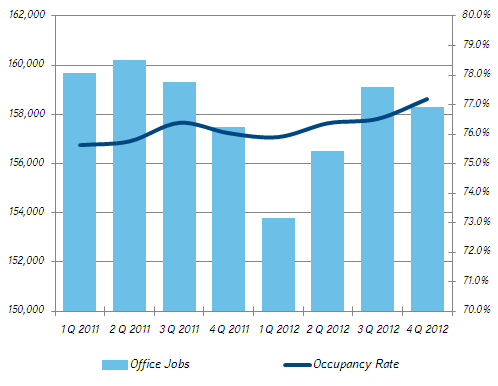
Last quarter, we said that Southern Nevada’s office market was in neutral. This quarter, it may have finally gotten into gear. For the third straight quarter, Southern Nevada’s office market posted positive net absorption and office vacancy decreased. Vacancy stood at 22.8 percent in the fourth quarter of 2012, feeding off of 265,336 square feet of net absorption. There were no new completions this quarter, and the weighted average asking rental rate fell to $1.88 per square foot (psf) on a Full Service Gross (FSG) basis. Given the office market’s recent history, one feels hesitant to let their joy be unrestrained, but it looks as though the office market might finally be in recovery mode.
According to the Nevada Department of Employment, Training & Rehabilitation, between November 2011 and November 2012, a net of 500 office sector jobs were gained in Southern Nevada. The professional & business services sector, which had been adding jobs in 2011, has dropped 400 jobs over the past twelve months. The financial activities sector, which includes insurance and real estate, continued its decline as well (though at a slower pace), losing 200 jobs over the past twelve months. The health care & social assistance sector added 1,100 jobs over the same period, though this sector has a limited impact on the professional office market. Unemployment in the Las Vegas-Paradise MSA stood at 10.4 percent as of November 2012, down from 13.0 percent in November 2011. Over the same period, total employment in Southern Nevada has increased by 6,300 jobs, the majority in the education and health services sector and the trade, transportation and utilities sector. The leisure and hospitality sector had been growing at a strong pace through much of 2012, but slowed in the latter half of the year.
If Southern Nevada’s office market is still bouncing along the bottom, then the fourth quarter of 2012 found it on the upward leg of its trajectory (and hopefully not its apogee). After five years of ill news, it would be our fondest desire to declare three quarters of positive (if somewhat weak) net absorption and falling vacancy rates a trend and predict a stellar 2013 for the office market. Two things (only two?) keep us from taking this plunge. The first is the uneven growth in office jobs, the foundation of demand for office space. If office jobs gains were clearly on the rise, it would be sensible to predict a strong 2013 for office demand. National and global headwinds, from the dreaded “fiscal cliff” to the slow-down (or potential slow-down) in Europe, China and Japan also keep the prognosis for Southern Nevada’s own economy in 2013 a bit hazy. By and large, the local economy should see continued slow growth in 2013, and we believe the office market will follow suit. If the economy does turn sour, though, expect continued difficulties for the office market as well.
According to the Nevada Department of Employment, Training & Rehabilitation, between November 2011 and November 2012, a net of 500 office sector jobs were gained in Southern Nevada. The professional & business services sector, which had been adding jobs in 2011, has dropped 400 jobs over the past twelve months. The financial activities sector, which includes insurance and real estate, continued its decline as well (though at a slower pace), losing 200 jobs over the past twelve months. The health care & social assistance sector added 1,100 jobs over the same period, though this sector has a limited impact on the professional office market. Unemployment in the Las Vegas-Paradise MSA stood at 10.4 percent as of November 2012, down from 13.0 percent in November 2011. Over the same period, total employment in Southern Nevada has increased by 6,300 jobs, the majority in the education and health services sector and the trade, transportation and utilities sector. The leisure and hospitality sector had been growing at a strong pace through much of 2012, but slowed in the latter half of the year.
If Southern Nevada’s office market is still bouncing along the bottom, then the fourth quarter of 2012 found it on the upward leg of its trajectory (and hopefully not its apogee). After five years of ill news, it would be our fondest desire to declare three quarters of positive (if somewhat weak) net absorption and falling vacancy rates a trend and predict a stellar 2013 for the office market. Two things (only two?) keep us from taking this plunge. The first is the uneven growth in office jobs, the foundation of demand for office space. If office jobs gains were clearly on the rise, it would be sensible to predict a strong 2013 for office demand. National and global headwinds, from the dreaded “fiscal cliff” to the slow-down (or potential slow-down) in Europe, China and Japan also keep the prognosis for Southern Nevada’s own economy in 2013 a bit hazy. By and large, the local economy should see continued slow growth in 2013, and we believe the office market will follow suit. If the economy does turn sour, though, expect continued difficulties for the office market as well.
Tuesday, February 5, 2013
A Good Year for Retail, But What Lies Ahead?
The fourth quarter of 2012 saw another quarter of positive performance for Southern Nevada’s retail market, the sixth quarter in a row and a sure sign that Las Vegas has some life left in it yet. While overall activity did not rise, it appears that fewer retailers are now downsizing or closing up shop, and that helped produce 117,731 square feet of positive net absorption. The vacancy rate has now decreased by 1.4 points over the past four quarters, reaching 10 percent in the fourth quarter of 2012. Asking rents have continued to slide, and there were no new completions of anchored retail this quarter.
Southern Nevada currently has 1.16 million square feet of big-box space available in the marketplace, representing a vacancy rate of 6.1 percent and at an average asking price of $0.94 psf NNN. Shop-space had a vacancy rate of 14.1 percent and asking rate of $1.41 psf NNN. While shop-space has a higher vacancy rate than big-box, the big-box’s hold about 24.6 percent of all the vacant retail space in Southern Nevada’s anchored centers. Net absorption (including vacant sublease space) in big-box space over the past quarter was 18,133 square feet. Shop space posted 291,470 square feet of net absorption over the same period. Filling big-box space could be a slow process, especially given the current trend in big-box retailing to downsize their stores in the face of “showrooming” by customers who browse in brick-and-mortal retail stores, but finalize their purchase online.
There is no denying that the retail market just finished up a productive 2012. Net absorption was positive for the year, gross absorption was up and overall vacancy is falling. Asking rents have not yet started to recover, but if demand for retail remains strong in 2013 that might change. Despite all of this positive news, there are concerns to be had about the future. Retail in Southern Nevada is overbuilt, and internet retail has the potential to put a damper on future demand for retail space even as consumer spending recovers. Much of the retail space that is now vacant was constructed at a time when making a project look good on paper trumped design considerations and, in some cases, common sense. As a result, much of the overhang of retail product will have a hard time ever attracting tenants, leaving Southern Nevada with two retail markets, one of well-located, well-designed centers commanding strong rents and boasting high occupancy, and another market of retail projects that languish on the margins. Despite these misgivings for the future, we still believe that the overall trajectory of the local retail market is positive, and will remain so in 2013 and beyond. The recovery we have been waiting for is finally here, and while it might not be stellar, it is real and appears to have legs.
Southern Nevada currently has 1.16 million square feet of big-box space available in the marketplace, representing a vacancy rate of 6.1 percent and at an average asking price of $0.94 psf NNN. Shop-space had a vacancy rate of 14.1 percent and asking rate of $1.41 psf NNN. While shop-space has a higher vacancy rate than big-box, the big-box’s hold about 24.6 percent of all the vacant retail space in Southern Nevada’s anchored centers. Net absorption (including vacant sublease space) in big-box space over the past quarter was 18,133 square feet. Shop space posted 291,470 square feet of net absorption over the same period. Filling big-box space could be a slow process, especially given the current trend in big-box retailing to downsize their stores in the face of “showrooming” by customers who browse in brick-and-mortal retail stores, but finalize their purchase online.
There is no denying that the retail market just finished up a productive 2012. Net absorption was positive for the year, gross absorption was up and overall vacancy is falling. Asking rents have not yet started to recover, but if demand for retail remains strong in 2013 that might change. Despite all of this positive news, there are concerns to be had about the future. Retail in Southern Nevada is overbuilt, and internet retail has the potential to put a damper on future demand for retail space even as consumer spending recovers. Much of the retail space that is now vacant was constructed at a time when making a project look good on paper trumped design considerations and, in some cases, common sense. As a result, much of the overhang of retail product will have a hard time ever attracting tenants, leaving Southern Nevada with two retail markets, one of well-located, well-designed centers commanding strong rents and boasting high occupancy, and another market of retail projects that languish on the margins. Despite these misgivings for the future, we still believe that the overall trajectory of the local retail market is positive, and will remain so in 2013 and beyond. The recovery we have been waiting for is finally here, and while it might not be stellar, it is real and appears to have legs.
Subscribe to:
Posts (Atom)