The economy is not only going through (or suffering through? – it seems like it sometimes) a recovery after a rather rough recession/depression/panic, it is also going through a transition that started with the invention of the World Wide Web, or really, with the invention of the computer itself. In truth, economies are almost always going through some sort of transition – innovations do not stop or start, but always seem to be trickling in. Computers and the internet, though, just like steam before them, are putting the global economy through a much larger transition than we might be used to. The effects are happening slowly; it takes time to find the next market efficiency, and most new market efficiencies are resisted by the existing major players and the congressmen they employ. But happening they are, and happen they will and your best bet is to get on board sooner rather than later.
Efficiency really is the name of the game. It is the reason capitalism, with its focus on competition, beats mercantilism (i.e. crony capitalism) and socialism. Efficiency in this regard means cutting costs – getting the most for the least – and commercial real estate is a great place to make those cuts. For one thing, values were forced to reset after the Great Recession. But more importantly, computers and the internet continue to change the way people work. Office tenants have been trending towards less office space per worker. Computers are only getting smaller, and smart phones and broadband allow more workers to be productive away from the office. So even when office firms are hiring and signing leases, it’s likely that they’ll be taking smaller spaces, relatively, than they did in the past, and this extends the time it will take for the office market to fully recover.
Medical office has been going through a similar transition. The day of the artisan doctor – one man in one office with his own receptionist and assistants – is over, and the new era of medical groups has arrived. Doctors become salaried employees who are not on call 24 hours a day, 7 days a week, several doctors share a receptionist and office staff, and ultimately take less medical office space per employee than they would have in the past. The reason for this transition is the screwed up world of health insurance and government regulations, of course, not technology, but it’s a transition just the same, and one that brokers should pay attention to. Moreover, healthcare providers are moving into retail centers to get closer to customers and, more importantly, to probably pay less for rent.
Retail has other problems though, in the form of online retail. Shopping online doesn’t cost more, and it’s often more convenient (two generations of rampant narcissism has done nothing to make the shopping experience more pleasant), so it’s on the rise. More online sales means less demand for physical retail real estate – witness mass closures of Staples and Radio Shack, and shrinking retail concepts from grocery to electronics.
The big winner in all this might be industrial space. If the trend is towards spending less on commercial real estate, industrial product, which tends to be less expensive than either retail or office space, becomes an option. This is particularly true when it comes to online retailers. While they do not need physical retail space, they do need physical warehouse space, and giants like Amazon appear to be aiming to have warehouse space in every major and minor city in the country to allow them to ship to their customers, and accept returns from their customers, as quickly as possible.
The slow post-Great Recession recovery is not just slow because it’s slow, it’s slow because businesses are forging a brand new identity and are finding brand new ways to do business. Commercial real estate will adapt to this transition, but only if real estate professionals recognize it. Those who do will likely reap the reward of being ahead of the competition.
Showing posts with label office. Show all posts
Tuesday, January 26, 2016
Tuesday, January 19, 2016
Not Obsolete - Demand Challenged
A few weeks ago, I began an investigation into obsolescence of buildings in the office market here in Southern Nevada. The question has been floating around for several years now: Is obsolete space artificially increasing Southern Nevada’s office vacancy. This is an interesting question, and not an easy question to answer.
The first challenge is in identifying what makes a property obsolete. The factors might be structural (i.e. how the property is designed) or geographic (i.e. where the property is located). The character of the ownership of a property might make it obsolete as well. All of these are important factors, but they not necessarily easy to quantify – at least not when you have a few hundred properties to work with.
The term obsolete is itself a problem, as needs change over time, a formerly “obsolete” property can become viable once again. Witness the brief moment before the Great Recession when vacant retail big boxes suddenly became attractive to call centers (before they moved to India and then moved back to the United States ...).
For my part, I decided to ditch the term obsolete, and use the term “less desirable”. To decide whether a property was less desirable, I first examined the lease comps we have collected over the past three years to determine the average time on market for each class of office.
On average, Class A availabilities remained on the market for 2.7 years before they were leased. Class B availabilities remained on the market for 2 years. Class C availabilities for 1.6 years. I then assumed that an availability that was on the market for twice as long as this average period of time was “less desirable” for one reason or another.
Using this assumption, I got the following stats:
Class A: 25% of available space is less desirable
Class B: 25% of available space is less desirable
Class C: 34% of available space is less desirable
If you removed this less desirable space from the market (without removing the “less desirable” buildings this space is in from total inventory), you would bring office vacancy down to around 13 percent. This appears to make the case that the office market, though not as healthy as it was before either the Great Recession or the Boom, is not as unhealthy as it seems.
I wasn’t done, though. I decided next to look the situation on a building by building basis, using the office market as my test case. It is possible to have a less desirable available unit in an otherwise desirable property, so simply looking at less desirable availabilities can skew our results. I wanted to figure out which properties in Southern Nevada were generally less desirable.
To figure out which buildings would make the list, I tallied the “less desirable” space in each building. If that space represented 50% or more of that building’s total size, I deemed the building “less desirable”.
What did I learn from this experiment?
1. There is a great deal of old space available in the office market. Medical office space is worse off than professional office space, and office space is worse off than industrial and retail space.
2. Medical Class B and Industrial Flex space stay fresher longer; the average Class B Medical unit was on the market for 1030 days before it leased, and for Flex 1380 days, indicating that tenants in these product types don’t care much if a space has been vacant for an extended period. Quickest turnover is in Incubator, Medical Class A and C and in Strip Centers.
3. Less desirable buildings are not the same thing as old buildings. The average age of less desirable buildings is 16 years, but the buildings themselves range in age from 5 to 37 years old.
4. Old parts of town do not dominate in the less desirable category. Properties built in the waning days of the Boom have struggled to absorb space. If any submarkets dominate, it is the Southwest along the Beltway, the Airport submarket and West Central. East Las Vegas, Henderson, Northwest, Downtown and the small North Las Vegas submarkets actually come off pretty well.
5. The Beltway is not a bust, but it does not seem to automatically increase the desirability of office space. Many of Southern Nevada’s less desirable properties are located near the 215. As alluded to above, the old center of the Valley – what we would characterize as Downtown, East Las Vegas and West Central – have the fewest “less desirable” buildings.
The first challenge is in identifying what makes a property obsolete. The factors might be structural (i.e. how the property is designed) or geographic (i.e. where the property is located). The character of the ownership of a property might make it obsolete as well. All of these are important factors, but they not necessarily easy to quantify – at least not when you have a few hundred properties to work with.
The term obsolete is itself a problem, as needs change over time, a formerly “obsolete” property can become viable once again. Witness the brief moment before the Great Recession when vacant retail big boxes suddenly became attractive to call centers (before they moved to India and then moved back to the United States ...).
For my part, I decided to ditch the term obsolete, and use the term “less desirable”. To decide whether a property was less desirable, I first examined the lease comps we have collected over the past three years to determine the average time on market for each class of office.
On average, Class A availabilities remained on the market for 2.7 years before they were leased. Class B availabilities remained on the market for 2 years. Class C availabilities for 1.6 years. I then assumed that an availability that was on the market for twice as long as this average period of time was “less desirable” for one reason or another.
Using this assumption, I got the following stats:
Class A: 25% of available space is less desirable
Class B: 25% of available space is less desirable
Class C: 34% of available space is less desirable
If you removed this less desirable space from the market (without removing the “less desirable” buildings this space is in from total inventory), you would bring office vacancy down to around 13 percent. This appears to make the case that the office market, though not as healthy as it was before either the Great Recession or the Boom, is not as unhealthy as it seems.
I wasn’t done, though. I decided next to look the situation on a building by building basis, using the office market as my test case. It is possible to have a less desirable available unit in an otherwise desirable property, so simply looking at less desirable availabilities can skew our results. I wanted to figure out which properties in Southern Nevada were generally less desirable.
To figure out which buildings would make the list, I tallied the “less desirable” space in each building. If that space represented 50% or more of that building’s total size, I deemed the building “less desirable”.
What did I learn from this experiment?
1. There is a great deal of old space available in the office market. Medical office space is worse off than professional office space, and office space is worse off than industrial and retail space.
2. Medical Class B and Industrial Flex space stay fresher longer; the average Class B Medical unit was on the market for 1030 days before it leased, and for Flex 1380 days, indicating that tenants in these product types don’t care much if a space has been vacant for an extended period. Quickest turnover is in Incubator, Medical Class A and C and in Strip Centers.
3. Less desirable buildings are not the same thing as old buildings. The average age of less desirable buildings is 16 years, but the buildings themselves range in age from 5 to 37 years old.
4. Old parts of town do not dominate in the less desirable category. Properties built in the waning days of the Boom have struggled to absorb space. If any submarkets dominate, it is the Southwest along the Beltway, the Airport submarket and West Central. East Las Vegas, Henderson, Northwest, Downtown and the small North Las Vegas submarkets actually come off pretty well.
5. The Beltway is not a bust, but it does not seem to automatically increase the desirability of office space. Many of Southern Nevada’s less desirable properties are located near the 215. As alluded to above, the old center of the Valley – what we would characterize as Downtown, East Las Vegas and West Central – have the fewest “less desirable” buildings.
Monday, December 15, 2014
Moving Targets
![]() |
| Are traditional doctors offices going the way of house calls? |
Economies are likewise driven to be efficient. Producing the most possible at the lowest price. Why? Because human beings demand it. There is almost no end to what human beings want, and therefore producers want to produce as much of something as they can, and consumers, who have so many desires, want to pay as little as possible. Ultimately, the marketplace is where consumers and producers meet in the middle.
Human beings can erect dams to manipulate the flow of water. Note that I said manipulate, not stop. The water cannot be stopped. Hoover Dam forces water through channels to spin dynamos, but it doesn’t stop the water from flowing. Other dams force the water into fields to irrigate crops, but they do not stop the water.
Likewise, human governments can erect regulations, taxes and other such things to manipulate the flow of an economy. They can make something artificially cheap or expensive, but eventually the market will, by hook or by crook, work around those artifices to put the product at the market price.
I’ve recently read an article about innovations in healthcare. The supply of healthcare is, like a river, finding a way around artificial impediments. Because the old way of delivering healthcare, via individual doctors and surgeons, has been made artificially expensive with cost-sharing "health insurance”, producers and consumers are finding a way to “meet in the middle” with medical groups, do-it-yourself treatment aided by handheld computers (let’s stop calling them cell phones – they’re really so much more), health clinics, etc.
At the moment, the victim of this market-driven innovation is medical office space. Medical office space was designed to serve the old market of doctors and patients. At the moment, it is being negatively impacted by the change in healthcare delivery – a change initiated not by the free market, but by large public and private institutions.
Will we, at some point, return to a more traditional model? Perhaps. As healthcare delivery moves away from the very institutions that sought to dominate it, they will have to adapt or die. In the meantime, medical office will have to adapt to the new way of doing things. It may do this by clever redesigns to serve medical groups and health clinics, or by repurposing itself to other uses. Thus the ebb and flow of commerce continues. Keep this in mind when dealing with developers and building owners. The consumer (in this case potential tenant or buyer) is always a moving target, and forces much larger than they are driving that movement. Spend some time understanding the macro-economy to better understand the micro-economies you deal with when you represent a landlord or tenant.
JMS
Tuesday, February 12, 2013
Office Gets Into Gear
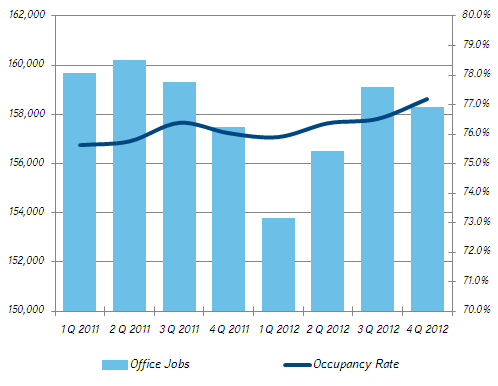
Last quarter, we said that Southern Nevada’s office market was in neutral. This quarter, it may have finally gotten into gear. For the third straight quarter, Southern Nevada’s office market posted positive net absorption and office vacancy decreased. Vacancy stood at 22.8 percent in the fourth quarter of 2012, feeding off of 265,336 square feet of net absorption. There were no new completions this quarter, and the weighted average asking rental rate fell to $1.88 per square foot (psf) on a Full Service Gross (FSG) basis. Given the office market’s recent history, one feels hesitant to let their joy be unrestrained, but it looks as though the office market might finally be in recovery mode.
According to the Nevada Department of Employment, Training & Rehabilitation, between November 2011 and November 2012, a net of 500 office sector jobs were gained in Southern Nevada. The professional & business services sector, which had been adding jobs in 2011, has dropped 400 jobs over the past twelve months. The financial activities sector, which includes insurance and real estate, continued its decline as well (though at a slower pace), losing 200 jobs over the past twelve months. The health care & social assistance sector added 1,100 jobs over the same period, though this sector has a limited impact on the professional office market. Unemployment in the Las Vegas-Paradise MSA stood at 10.4 percent as of November 2012, down from 13.0 percent in November 2011. Over the same period, total employment in Southern Nevada has increased by 6,300 jobs, the majority in the education and health services sector and the trade, transportation and utilities sector. The leisure and hospitality sector had been growing at a strong pace through much of 2012, but slowed in the latter half of the year.
If Southern Nevada’s office market is still bouncing along the bottom, then the fourth quarter of 2012 found it on the upward leg of its trajectory (and hopefully not its apogee). After five years of ill news, it would be our fondest desire to declare three quarters of positive (if somewhat weak) net absorption and falling vacancy rates a trend and predict a stellar 2013 for the office market. Two things (only two?) keep us from taking this plunge. The first is the uneven growth in office jobs, the foundation of demand for office space. If office jobs gains were clearly on the rise, it would be sensible to predict a strong 2013 for office demand. National and global headwinds, from the dreaded “fiscal cliff” to the slow-down (or potential slow-down) in Europe, China and Japan also keep the prognosis for Southern Nevada’s own economy in 2013 a bit hazy. By and large, the local economy should see continued slow growth in 2013, and we believe the office market will follow suit. If the economy does turn sour, though, expect continued difficulties for the office market as well.
According to the Nevada Department of Employment, Training & Rehabilitation, between November 2011 and November 2012, a net of 500 office sector jobs were gained in Southern Nevada. The professional & business services sector, which had been adding jobs in 2011, has dropped 400 jobs over the past twelve months. The financial activities sector, which includes insurance and real estate, continued its decline as well (though at a slower pace), losing 200 jobs over the past twelve months. The health care & social assistance sector added 1,100 jobs over the same period, though this sector has a limited impact on the professional office market. Unemployment in the Las Vegas-Paradise MSA stood at 10.4 percent as of November 2012, down from 13.0 percent in November 2011. Over the same period, total employment in Southern Nevada has increased by 6,300 jobs, the majority in the education and health services sector and the trade, transportation and utilities sector. The leisure and hospitality sector had been growing at a strong pace through much of 2012, but slowed in the latter half of the year.
If Southern Nevada’s office market is still bouncing along the bottom, then the fourth quarter of 2012 found it on the upward leg of its trajectory (and hopefully not its apogee). After five years of ill news, it would be our fondest desire to declare three quarters of positive (if somewhat weak) net absorption and falling vacancy rates a trend and predict a stellar 2013 for the office market. Two things (only two?) keep us from taking this plunge. The first is the uneven growth in office jobs, the foundation of demand for office space. If office jobs gains were clearly on the rise, it would be sensible to predict a strong 2013 for office demand. National and global headwinds, from the dreaded “fiscal cliff” to the slow-down (or potential slow-down) in Europe, China and Japan also keep the prognosis for Southern Nevada’s own economy in 2013 a bit hazy. By and large, the local economy should see continued slow growth in 2013, and we believe the office market will follow suit. If the economy does turn sour, though, expect continued difficulties for the office market as well.
Tuesday, January 24, 2012
Digging Into the Office Data
Aside from my normal analysis for the quarterly reports, most of my analysis comes about due to my mind wandering while I'm updating my database (a three to four hour task every day of the week).
Yesterday, I began to wonder about where the net absorption had been going over the last decade in the office market - sort of looking back to look forward.
So, today I put together some numbers comparing the share of office net absorption claimed by the different classes of product and the different submarkets here in Fabulous Las Vegas (or Fabulous Southern Nevada, to be more precise).
No surprise here. Southern Nevada is a third tier office market that leans heavily on its Class B and Class C product. If we look at this same graph, but leaving out the last 4 years of recession-era data ...
... we see that over the last four year a tiny shift from Class C to Class A and Class B product has occurred, most likely a result of lower rents allowing businesses to "move up in the world" and take better space.
The recession has been felt most keenly by the older submarkets of East Las Vegas and West Central, with both turning in negative net absorption for the decade. The Southwest and Henderson submarkets appear to have been the key benefactors of this flight.
Screening out the recession data, we see that East Las Vegas and West Central turn positive, but not by much. More interesting, perhaps, is the switch between Henderson and the Northwest submarket. Pre-recession, Northwest was firing on all cylinders. Unfortunately, a great deal of its office space was caught up in the restructuring of General Growth Properties, and languished in the form of "zombie buildings", unable to offer tenant improvements and thus compete with non-distressed office space elsewhere.
Henderson has done well, but they're about to lose a significant tenant in the form of Zappos.com, which is moving to the Downtown submarket by 2014.
Moving forward, one might want to focus on Class B and Class C office product in the Southwest and Northwest submarkets, and perhaps in the Airport and Henderson submarkets as well. All of these classes of office have fairly high vacancy rates in these submarkets at the moment ...
... so there's probably little need for development over the next few years. Class B product in the Airport submarket looks the most promising, but it is worth remembering that there isn't much vacant land on which to develop large office products in the Airport submarket - most of that sort of development will probably be shifted south into the western reaches of the Henderson submarket if it occurs at all.
I'll leave you with the following graph, which tracks quarterly office net absorption by class over the past decade. It's been quite a roller coaster ride, but at least things look to be heading up, assuming we can weather the deleveraging storm on the horizon.
Yesterday, I began to wonder about where the net absorption had been going over the last decade in the office market - sort of looking back to look forward.
So, today I put together some numbers comparing the share of office net absorption claimed by the different classes of product and the different submarkets here in Fabulous Las Vegas (or Fabulous Southern Nevada, to be more precise).
Share of Net Absorption by Class, 2001-2011
No surprise here. Southern Nevada is a third tier office market that leans heavily on its Class B and Class C product. If we look at this same graph, but leaving out the last 4 years of recession-era data ...
Share of Net Absorption by Class, 2001-2007
... we see that over the last four year a tiny shift from Class C to Class A and Class B product has occurred, most likely a result of lower rents allowing businesses to "move up in the world" and take better space.
Share of Net Absorption by Submarket, 2001-2011
The recession has been felt most keenly by the older submarkets of East Las Vegas and West Central, with both turning in negative net absorption for the decade. The Southwest and Henderson submarkets appear to have been the key benefactors of this flight.
Share of Net Absorption by Submarket, 2001-2007
Screening out the recession data, we see that East Las Vegas and West Central turn positive, but not by much. More interesting, perhaps, is the switch between Henderson and the Northwest submarket. Pre-recession, Northwest was firing on all cylinders. Unfortunately, a great deal of its office space was caught up in the restructuring of General Growth Properties, and languished in the form of "zombie buildings", unable to offer tenant improvements and thus compete with non-distressed office space elsewhere.
Henderson has done well, but they're about to lose a significant tenant in the form of Zappos.com, which is moving to the Downtown submarket by 2014.
Moving forward, one might want to focus on Class B and Class C office product in the Southwest and Northwest submarkets, and perhaps in the Airport and Henderson submarkets as well. All of these classes of office have fairly high vacancy rates in these submarkets at the moment ...
... so there's probably little need for development over the next few years. Class B product in the Airport submarket looks the most promising, but it is worth remembering that there isn't much vacant land on which to develop large office products in the Airport submarket - most of that sort of development will probably be shifted south into the western reaches of the Henderson submarket if it occurs at all.
I'll leave you with the following graph, which tracks quarterly office net absorption by class over the past decade. It's been quite a roller coaster ride, but at least things look to be heading up, assuming we can weather the deleveraging storm on the horizon.
Tuesday, January 17, 2012
Office Dead Zones!
Last week we took a look at where all of the distressed office space was located in Southern Nevada, and discovered no real pattern.
Today, it's time to take a look at office activity in 2011 and seek out the dead zones - those areas of town that didn't show much, if any, lease or sales activity (i.e. gross absorption).
This map plots two different sets of data.
The first, in the large, grey dots, are the locations of available office spaces in Southern Nevada in 2011.
The second, in the smaller, yellow dots, are the locations of office buildings that saw their total square footage of available space decrease between the fourth quarter of 2010 and the fourth quarter of 2011. If I get some more spare time, I'll do this exercise on a quarter-by-quarter basis, but this map will have to do for now - and it does show the location of about 3.3 million square feet of lease and sales activity.
So, what do we learn?
At first glance, it seems as though there is no big pattern. Businesses are taking space all over town, and this probably indicates that the key driver is not location or age of property, but price. We are probably seeing a flight to affordability, rather than a flight to quality.
With a closer inspection, though, we do see a few small dead zones.
The first dead zone is on the southern portion of Fort Apache, near the "Curve" of I-215. While these projects are fairly easy to access via I-215, they appear to be just far enough off the beaten path to be struggling.
There are avails in North Las Vegas that are having trouble competing, but North Las Vegas, on the whole, appears to be doing fairly well in terms of leasing activity.
More interesting is the dead stretch on west Cheyenne, between US-95 and I-215. This is Summerlin territory, and traditionally highly sought after. This may bolster the case for "flight to affordability", but might also show the impact of distressed space on leasing. A few projects in this area were up in limbo until recently, and unable to effectively compete for tenants.
The final dead zone - and not a surprise - is located on Lake Mead Blvd in Henderson. It's a bit out of the way, and not an area known for its office product.
Other than those few zones, it appears that leasing and sales are taking place wherever there is space available - assuming the price is right.
Today, it's time to take a look at office activity in 2011 and seek out the dead zones - those areas of town that didn't show much, if any, lease or sales activity (i.e. gross absorption).
This map plots two different sets of data.
The first, in the large, grey dots, are the locations of available office spaces in Southern Nevada in 2011.
The second, in the smaller, yellow dots, are the locations of office buildings that saw their total square footage of available space decrease between the fourth quarter of 2010 and the fourth quarter of 2011. If I get some more spare time, I'll do this exercise on a quarter-by-quarter basis, but this map will have to do for now - and it does show the location of about 3.3 million square feet of lease and sales activity.
![]() |
| Click the image for a magnified view. |
So, what do we learn?
At first glance, it seems as though there is no big pattern. Businesses are taking space all over town, and this probably indicates that the key driver is not location or age of property, but price. We are probably seeing a flight to affordability, rather than a flight to quality.
With a closer inspection, though, we do see a few small dead zones.
The first dead zone is on the southern portion of Fort Apache, near the "Curve" of I-215. While these projects are fairly easy to access via I-215, they appear to be just far enough off the beaten path to be struggling.
There are avails in North Las Vegas that are having trouble competing, but North Las Vegas, on the whole, appears to be doing fairly well in terms of leasing activity.
More interesting is the dead stretch on west Cheyenne, between US-95 and I-215. This is Summerlin territory, and traditionally highly sought after. This may bolster the case for "flight to affordability", but might also show the impact of distressed space on leasing. A few projects in this area were up in limbo until recently, and unable to effectively compete for tenants.
The final dead zone - and not a surprise - is located on Lake Mead Blvd in Henderson. It's a bit out of the way, and not an area known for its office product.
Other than those few zones, it appears that leasing and sales are taking place wherever there is space available - assuming the price is right.
Subscribe to:
Comments (Atom)