Thursday, February 21, 2013

What Lies Ahead for Medical Office?

After a strong third quarter, medical office fell back into negative net absorption in the fourth quarter of 2012. For the year as a whole, medical office returned 61,723 square feet to the market, net, despite a steady increase in health care oriented employment. Why such a discrepancy between jobs and net absorption? Health care in the United States, and the medical practitioners who deliver it and occupy medical office space, are going through a transition period. Not only are the days of private practice falling to the rise of medical groups, who require less space to do the same work, but the need for efficiency and lower prices are shifting medical resources from the traditional medical office buildings (MOB’s) of the past to new concepts that often take space in retail centers to be closer to their patients. The times are changing for medical office.


The rise of medical groups, such as Accountable Care Organizations (ACO’s), and alternative vectors of providing healthcare are putting the squeeze on medical office right now. Doctors, insurers and patients are all going through a slow discovery process of just what the Affordable Care Act means to them, and doctors and insurers are especially trying to come to grips with what these government-mandated changes will mean to their business models. Owners of medical space also need to come to grips with the changes that are on the horizon for medical care. With group practices and urgent care facilities set to dominate healthcare delivery in the future, medical office buildings will need to be retro-fitted to accommodate these tenants, and that requires a capital investment. With margins likely tightening, passing these tenant improvements on to the tenants will be tricky.


The uneven application of “Obamacare”, compounded by balking among members of the president’s own party regarding associated taxes, should insure a bumpy road for medical office over at least the next four years. More importantly, while the government-medical complex is working out the kinks, private enterprise will continue to innovate in the health care arena. From Wal-Mart’s foray into small pharmacies on medical campuses to health care in Targets, more and more medical office dollars are going to flow into non-medical real estate, putting the crunch on landlords already dealing with consolidations and downsizing among physicians. We think we will continue to see the medical office market bounce along the bottom in 2013 while medical office users survey the new medical landscape and prepare for the future.


Thursday, February 14, 2013

2013 - Are You a Good Year, or a Bad Year?

As we bid a fond farewell (or good riddance) to 2012 and usher in brand spankin' new 2013, it is natural to wonder just what we're getting ourselves into.

After all, 2011 was a pretty decent year for Las Vegas CRE, so it was a bit of a shock when 2012 hit us like a ton of bricks. Fortunately, 2012 got a bit sunnier at the end of the year, but will the trend continue? Will 2013 be a good year for Las Vegas CRE, or another washout year like 2012? Well, let's look at the index ...


The CRE Recovery Index was on its way up through most of 2012, predicting that positive movement towards the end of the year. But in September, the index began to go flat, and in November and December it began to fall. In and of itself, this is not odd – it usually does begin to fall towards the end of the year, and on the positive side, the decline in 2012 was not as severe as in the past two years. In general, the rise of the index in 2012 was more stable than in 2011, and there is every reason to believe that this slow and steady rise will be seen again when January and February numbers become available to us.


On a year-over-year basis, the December 2012 New Home Sales index and Taxable Sales were up sharply, and increases were also seen in the Commercial Occupancy index (finally), Visitor Volume and Employment. Port traffic in Los Angeles was down considerably on a year-over-year basis – a minor factor in the overall CRE Recovery Index – and Gaming Revenue was down as well.

In general, the cycle appears to be operating as usual. Growth was slower and steadier in 2012 than in 2011, and at the moment we can probably expect 2013 to look similar. Higher taxes and increased costs for healthcare and health insurance, along with the currency wars that are being fought between the industrialized debtor nations of the world, might hamper that growth, though, so keep your head on a swivel.

Tuesday, February 12, 2013

Office Gets Into Gear

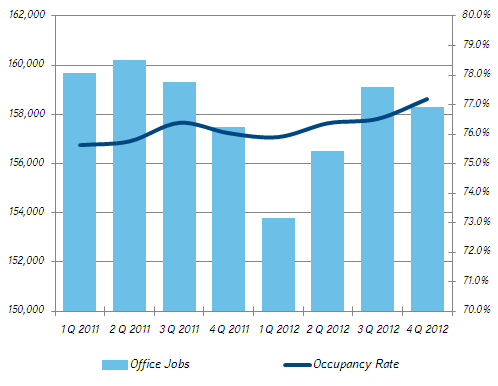
Last quarter, we said that Southern Nevada’s office market was in neutral. This quarter, it may have finally gotten into gear. For the third straight quarter, Southern Nevada’s office market posted positive net absorption and office vacancy decreased. Vacancy stood at 22.8 percent in the fourth quarter of 2012, feeding off of 265,336 square feet of net absorption. There were no new completions this quarter, and the weighted average asking rental rate fell to $1.88 per square foot (psf) on a Full Service Gross (FSG) basis. Given the office market’s recent history, one feels hesitant to let their joy be unrestrained, but it looks as though the office market might finally be in recovery mode.


According to the Nevada Department of Employment, Training & Rehabilitation, between November 2011 and November 2012, a net of 500 office sector jobs were gained in Southern Nevada. The professional & business services sector, which had been adding jobs in 2011, has dropped 400 jobs over the past twelve months. The financial activities sector, which includes insurance and real estate, continued its decline as well (though at a slower pace), losing 200 jobs over the past twelve months. The health care & social assistance sector added 1,100 jobs over the same period, though this sector has a limited impact on the professional office market. Unemployment in the Las Vegas-Paradise MSA stood at 10.4 percent as of November 2012, down from 13.0 percent in November 2011. Over the same period, total employment in Southern Nevada has increased by 6,300 jobs, the majority in the education and health services sector and the trade, transportation and utilities sector. The leisure and hospitality sector had been growing at a strong pace through much of 2012, but slowed in the latter half of the year.


If Southern Nevada’s office market is still bouncing along the bottom, then the fourth quarter of 2012 found it on the upward leg of its trajectory (and hopefully not its apogee). After five years of ill news, it would be our fondest desire to declare three quarters of positive (if somewhat weak) net absorption and falling vacancy rates a trend and predict a stellar 2013 for the office market. Two things (only two?) keep us from taking this plunge. The first is the uneven growth in office jobs, the foundation of demand for office space. If office jobs gains were clearly on the rise, it would be sensible to predict a strong 2013 for office demand. National and global headwinds, from the dreaded “fiscal cliff” to the slow-down (or potential slow-down) in Europe, China and Japan also keep the prognosis for Southern Nevada’s own economy in 2013 a bit hazy. By and large, the local economy should see continued slow growth in 2013, and we believe the office market will follow suit. If the economy does turn sour, though, expect continued difficulties for the office market as well.


Tuesday, February 5, 2013

A Good Year for Retail, But What Lies Ahead?

The fourth quarter of 2012 saw another quarter of positive performance for Southern Nevada’s retail market, the sixth quarter in a row and a sure sign that Las Vegas has some life left in it yet. While overall activity did not rise, it appears that fewer retailers are now downsizing or closing up shop, and that helped produce 117,731 square feet of positive net absorption. The vacancy rate has now decreased by 1.4 points over the past four quarters, reaching 10 percent in the fourth quarter of 2012. Asking rents have continued to slide, and there were no new completions of anchored retail this quarter.


Southern Nevada currently has 1.16 million square feet of big-box space available in the marketplace, representing a vacancy rate of 6.1 percent and at an average asking price of $0.94 psf NNN. Shop-space had a vacancy rate of 14.1 percent and asking rate of $1.41 psf NNN. While shop-space has a higher vacancy rate than big-box, the big-box’s hold about 24.6 percent of all the vacant retail space in Southern Nevada’s anchored centers. Net absorption (including vacant sublease space) in big-box space over the past quarter was 18,133 square feet. Shop space posted 291,470 square feet of net absorption over the same period. Filling big-box space could be a slow process, especially given the current trend in big-box retailing to downsize their stores in the face of “showrooming” by customers who browse in brick-and-mortal retail stores, but finalize their purchase online.


There is no denying that the retail market just finished up a productive 2012. Net absorption was positive for the year, gross absorption was up and overall vacancy is falling. Asking rents have not yet started to recover, but if demand for retail remains strong in 2013 that might change. Despite all of this positive news, there are concerns to be had about the future. Retail in Southern Nevada is overbuilt, and internet retail has the potential to put a damper on future demand for retail space even as consumer spending recovers. Much of the retail space that is now vacant was constructed at a time when making a project look good on paper trumped design considerations and, in some cases, common sense. As a result, much of the overhang of retail product will have a hard time ever attracting tenants, leaving Southern Nevada with two retail markets, one of well-located, well-designed centers commanding strong rents and boasting high occupancy, and another market of retail projects that languish on the margins. Despite these misgivings for the future, we still believe that the overall trajectory of the local retail market is positive, and will remain so in 2013 and beyond. The recovery we have been waiting for is finally here, and while it might not be stellar, it is real and appears to have legs.


Friday, February 1, 2013

Industrial Looks to 2013 (‘Cause 2012 Is Better Forgotten)

Excerpts from the Colliers International Q4 Las Vegas Industrial Report ...

While the office and retail markets in Southern Nevada continue to improve, the industrial market appears to be the wallflower of commercial real estate. The culprit is most likely the construction sector, for other sectors of industrial employment are showing year-over-year job gains. After a positive year of net absorption in 2011, the industrial market gave back 268,000 square feet of occupied space in 2012. The vacancy rate increased to a new high of 15 percent, and asking rental rates dropped, year-over-year, by $0.03, to $0.48 per square foot (psf) on a triple-net (NNN) basis. For the industrial market, recovery remains elusive.


By any measure, 2012 was a disappointment, though not necessarily a surprising disappointment. The surge in industrial activity experienced in the middle of 2011 raised hopes, but the slow down experienced in late 2011 tempered expectations for the new year, and most people understood that there were head winds to overcome. Industrial employment growth was weak in 2012, and demand for industrial space generally followed suit. As people once again begin moving into Southern Nevada and the available housing inventory is slowly drawn down, the construction sector should find its bottom and then begin to grow. This could still be a two to three year process, but unraveling the problems created during the housing bubble is a tricky thing that cannot be rushed. Several build-to-suit industrial projects are slated to be completed in 2013, and this should help improve the numbers, at least temporarily, but it seems increasingly unlikely that Southern Nevada’s industrial market will really recover until the construction sector finally stabilizes and then begins to grow again. We think 2013 holds the possibility of slow growth, but it is more likely that 2013 will be another difficult year for the industrial market, with as many negatives as positives.

Click here for the full report

Wednesday, January 16, 2013

Gazing in the Crystal Ball for 2013

I'm going to start posting some excerpts from the Q4-2012 reports on this blog, but first decided I'd do a little forecasting with the CRE Recovery Index.

In general, 2012 had a decent close for office and retail, though industrial (and specifically warehouse/distribution) continued to show weakness, and in fact took a step back in 2012. While predictions for economic growth (national) in 2013 vary widely, few economists seem to think 2013 is going to be especially strong - perhaps better than 2012, but not stellar.

The CRE Recovery Index would seem to support that supposition for early 2013, as it hit a three month plateau and then dropped slightly in November. In all, 2012 showed steadier growth than 2011, which was a real roller coaster. A depressed index in late 2012 points to a depressed first half (or at least first quarter) in commercial real estate.

In November, the index components worked out as follows:

New Home Sales: +7 Y-O-Y - new home sales are showing a definite improvement in Southern Nevada, hitting a level we haven't seen since early 2009. They still have a really long way to go, but any positive movement here is welcome.

Commercial Occupancy: +1 Y-O-Y - it took a long time to get this index to move, but strong net absorption numbers in the retail and office markets finally got commercial occupancy to increase by a click in August 2012. These numbers are quarterly, and the fourth quarter saw no movement over the third quarter.

Visitor Volume: +0 Y-O-Y - visitor volume in Southern Nevada, despite being flat in November on a year-over-year basis, was in record territory in 2012.

Gaming Revenue: +1 Y-O-Y - in general, gaming revenue has not been as strong as visitor volume - more people, but less gambling - but it is showing recovery from the depths of the recession.

New Residents: +6 Y-O-Y - this is probably the more important index to watch. Many would hold that construction was the second pillar of Southern Nevada's economy, but they're only partially correct. Migration was the second pillar of our economy, with construction being a very visible component of migration into the Valley. People are once again coming to our balmy shores (okay, we don't have shores, but you know what I mean), and that should go a long way to helping the local economy to recover.

Employment: +1 Y-O-Y - employment has been only marginally better in 2012 than 2011 and 2010. The hospitality sector posted strong job gains in the early part of 2012, but has now settled back down. Government is hiring again (take that whichever way you want), as is the health services sector (though it isn't translating into increased demand for medical office space), while construction and financial services are still the big losers. In terms of local CRE health, new residents is phase one, new jobs is phase two. We're seeing movement in phase one, so we will hopefully see phase two light up in 2013.

Taxable Sales: +5 Y-O-Y - taxable sales is the other big mover for Southern Nevada in 2012. The taxable sales index went from an average of 79 in 2010, to an average of 83 in 2011 to 2012's average of 88. Definite progress, and probably why the retail sector is showing signs of being the first sector to post real, solid recovery in the market.

Port Traffic: -6 Y-O-Y - port traffic in Los Angeles is a minor part of the index, and overall is stronger than it was before the recession.

All in all, look for a slow start to 2013, with retail probably showing the most resilience. The office market did well in late 2012, but employment growth in office sectors is marginal and I frankly don't trust it. Outside of warehouse/distribution, industrial is doing well - it will unfortunately probably do more of the same in early 2013.

Tuesday, December 11, 2012

Whither Diversification?

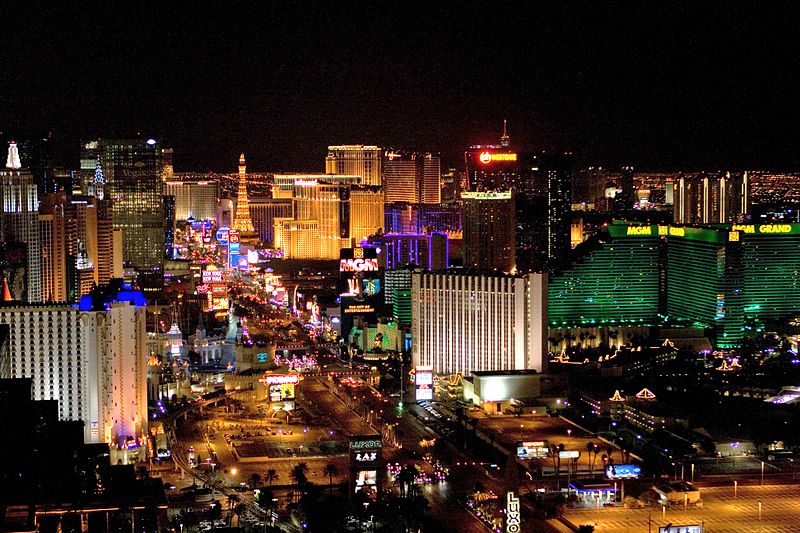
Photo by Lasvegaslover, found at Wikipedia
Another meeting of economists and business people in Las Vegas, and another mention of economic diversification, the mirage of our desert home that always seems a bit out of reach. We rely too much on hospitality and tourism, it is said, and if our economy does not diversify, we’ll continue to suffer disproportionately from recessions as we have for the last 5 years. We must diversify.

Of course, this raises a few points.

First and foremost, we’re suffering more than others in this current Great Recession because of our (formerly) huge construction sector. Perhaps too much of our local economy was invested in construction and mortgage financing (though wouldn't that count as diversification? and didn't it exist because there was a demonstrable need for it to exist?), and the loss of 80,000 construction jobs has no doubt put a bit of a hitch in our giddyap. But through most of the city’s history, we’ve entered national recessions late, left them early, and suffered far less than other communities while the recessions lasted. This latest recession simply hit us where we lived.

Second – Diversification is, to some extent, a wild thing not easily raised in captivity. If we haven’t diversified yet, it might be because other than a permissive attitude to booze, gambling and questionable taste in the name of a good time, Southern Nevada has very few natural resources. We have a river close by, but that’s already been dammed. We had wide open spaces up north, but those are already filled with atomic bomb craters and UFO research facilities. What, precisely, does Las Vegas offer to the world that the world is not already aware of? If somebody can find the cure for cancer in caliche or find a way to squeeze power out of the sun without the need for massive government subsidies (sorry kids, it's a profit and loss system and that isn't going to change any time soon) we’re all set, but otherwise we don’t have much to work with.

Third – I know, in the age of the internet, many businesses can operate anywhere, so why not operate in Fabulous Las Vegas? Well, Las Vegas does have a few things to offer the modern web-savvy business – the greatest internet connectivity in the world, a tax structure that favors start-ups and gazelles and the presence of Tony Hsieh come immediately to mind. On the other hand, the density of people living on the coasts suggest that, if a person can live and work absolutely anywhere, they will probably choose San Francisco, Los Angeles or Seattle before they will set up shop in Las Vegas.

Some folks will point out that the reason we don’t get our fair share (there is no such thing, by the way) of tech companies is that we don’t have the greatest education system in the world. Of course, Steve Jobs and Bill Gates didn’t have the most stellar careers in higher education in the world and managed to do pretty well for themselves in the world of tech, but I concede the point. We could invest in churning out highly educated people, of course, but ask Iowa how well that’s worked out for them – wonderful higher education system, and tons of educated Iowans now living and working outside of Iowa. The problem for Las Vegas is that, like agricultural Iowa, it has no need for a highly educated work force right now. We would be faced with the problem of producing the supply to attract the demand, and the supply (educated human beings) couldn’t very well wait around for the demand to show up – once they’re out of school, they need a job, and I fear they would find that job elsewhere.

At the heart of the problem, I think, is that Las Vegas, as it exists today, should probably not exist as it does today. Given the resources of the area, Las Vegas should probably be about the size of Bakersfield or Barstow, California – a stop on the road for people heading out to the beach. A weird series of circumstances, including legalized gambling and a number of government construction projects (Hoover Dam, Nellis AFB, the magnesium plants in Henderson during the Second World War, etc.) have conspired to place a remarkable number of people in the middle of the Mojave desert, and this has created the illusion that this city of 2 million people is just another large American city. Of course, this is not the case – we’re a rather strange, large American city, and the economic diversification one finds elsewhere may be tricky to achieve in Las Vegas, at least in the way some folks want to achieve it.

Perhaps the greatest resource of Las Vegas is its laissez-faire attitude. New rules in California governing the adult film industry could send more film makers to Las Vegas. "Great," folks might say, "let's add porn to our resume of sin." But the adult film industry is an industry, and it might have a compelling reason to relocate some production to Las Vegas. Jobs are jobs, right?

Likewise, we’re seeing more and more holding companies springing up in Las Vegas, since people want to own California businesses, but they don’t want to own California businesses in California because of the heavy tax burden in that state.

Medical tourism seems to be a possibility, since it allows us to play off our strength – serving tourists – and perhaps there are other ways to spin our expertise in hospitality into other industries.

That being said, none of the above are likely to ever rival leisure and hospitality in terms of employment in the Valley, and maybe that’s okay. For all its diversification, Houston is still dominated by the energy industry. Maybe the best plan for Las Vegans is to relax and let nature take its course. Given the resources at our disposal, Las Vegas has beaten all the odds to become the city it is today, and the same human genius (i.e. greed and ambition) that inspired Bugsy Siegel to build a resort in the desert south of Las Vegas may well find a way to diversify its economy in the future without having to resort to the horrors of convening a committee of experts.
Related Posts Plugin for WordPress, Blogger...